Dimdima
Online Children's Magazine from India
Dimdima
Online Children's Magazine from India





First Humans in Moon Orbit
Apollo 7 was put into orbit by the smaller of the two Saturn rockets, Saturn 1B. Its successor, Apollo 8 which was to orbit the moon required the power of the much larger Saturn V.
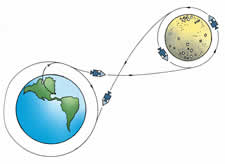
Apollo 8, crewed by veteran astronauts Frank Borman and James Lovell, and novice William A. Anders, took off on December 21, 1968. It was first put into a ‘parking orbit’ around Earth, and after a check of its systems showed that everything was okay, was catapulted towards the Moon by the firing of the third stage of the Saturn V rocket. Had anything gone wrong on this outward journey, Apollo’s trajectory allowed it to swing around the far side of the Moon and return safely to Earth. But everything proceeded smoothly and when the spacecraft neared the Moon the engine of the Service Propulsion System fired to place Apollo 8 in Moon orbit.
Orbiting just 110 kilometres above the lunar surface, the three astronauts became the first humans to come under the gravitational control of a celestial body other than Earth. One can imagine the awe with which they viewed the scarred and cratered surface of another world. They described all that they saw and took extensive photographs of possible landing sites. They took several photographs of Earth too, the first taken by humans from deep space.
“ The Earth looks pretty small from here,” commented Lovell, as they made ten orbits of the Moon, over a period of 20 hours 7 minutes.
EXPLORE MORE...
Get Help or Give Help.
- Do you have a Science Question?
- Post it here and get the answer.
- Some questions posted by others are not yet answered.
- View those questions and answer them.
Dimdima is the Sanskrit word for ‘drumbeat’. In olden days, victory in battle was heralded by the beat of drums or any important news to be conveyed to the people used to be accompanied with drumbeats.
Bharatiya Vidya Bhavan
K. M Munshi Marg,
Chowpatty, Mumbai - 400 007
email : editor@dimdima.com
Bharatiya Vidya Bhavan
505, Sane Guruji Marg,
Tardeo, Mumbai - 400 034
email : promo@dimdima.com
Dimdima.com, the Children's Website of Bharatiya Vidya Bhavan launched in 2000 and came out with a Printed version of Dimdima Magazine in 2004. At present the Printed Version have more than 35,000 subscribers from India and Abroad.