
Dimdima
Online Children's Magazine from India
Dimdima
Online Children's Magazine from India







Back to Earth
Neil Armstrong and Buzz Aldrin set up various equipments on the Moon including a seismograph for measuring moonquakes, and a device to reflect laser beams back to Earth. This device enabled scientists to measure the distance of the Moon from Earth to within a few centimeters. The astronauts also collected over 24 kilograms of rock and soil.
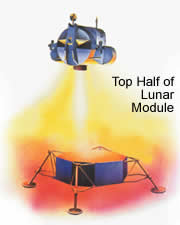
Armstrong’s moonwalk lasted a little over 2 hours while Aldrin’s a little under 2 hours. About 21 hours after they had landed, the duo crawled back into the EAGLE and blasted off from the Moon’s surface in the top half of the Lunar Module.
They soon rejoined the third member of the Apollo team, Michael Collins who had been patiently circling the Moon in the Command Module (COLUMBIA) while his colleagues on the moon’s surface were making history.
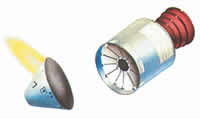 Jettisoning the Lunar Module, Apollo 11 left lunar orbit, on 22 July. It entered Earth’s atmosphere two days later, and splashed down in the Pacific Ocean, to bring to a successful and glorious end one of the greatest adventures man had ever undertaken.
Two countries had started out on the race to the moon. The U.S. had reached first, where was the Soviet Union?
Even as Apollo 11 was orbiting the Moon, the Soviet probe Luna 15 was heading for its surface in an attempt to collect some lunar soil ahead of the Americans. But the attempt ended in failure. The spacecraft crashed while trying to land, on the very day that the EAGLE touched down safely on it.
EXPLORE MORE...
Get Help or Give Help.
- Do you have a Science Question?
- Post it here and get the answer.
- Some questions posted by others are not yet answered.
- View those questions and answer them.
Dimdima is the Sanskrit word for ‘drumbeat’. In olden days, victory in battle was heralded by the beat of drums or any important news to be conveyed to the people used to be accompanied with drumbeats.
Bharatiya Vidya Bhavan
K. M Munshi Marg,
Chowpatty, Mumbai - 400 007
email : editor@dimdima.com
Bharatiya Vidya Bhavan
505, Sane Guruji Marg,
Tardeo, Mumbai - 400 034
email : promo@dimdima.com
Dimdima.com, the Children's Website of Bharatiya Vidya Bhavan launched in 2000 and came out with a Printed version of Dimdima Magazine in 2004. At present the Printed Version have more than 35,000 subscribers from India and Abroad.