
Dimdima
Online Children's Magazine from India
Dimdima
Online Children's Magazine from India









Father of Chest Medicine
| Date of Birth-Death :1781 - 1826 |
| Country of Birth : France |
| Major Discoveries : Stethoscope |
|
Writing by the Scientist with year of publication : On Mediate Auscultation," or the French version "De l' auscultation Mediate, ou traite du diagnostic des maladies du coeur," (1819) |
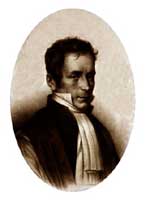
Rene Theophile Hyacinthe Laennec had a humble beginning. His first entry into the field of medicine was as an apprentice to his surgeon uncle. At the age of 19, he enrolled to study medicine in Ecole de Medicin, Paris, but had little money to continue his studies. He participated in contests in surgery and medicine, which won him prize money to pay his college fees.
Even as a student, he was able to distinguish from the different sounds in the chest of his patients that they were suffering from a specific disease. He published several papers on this topic.
In those days, the only way a doctor could hear the sounds of the heart and the chest was by placing his ear on the patients’ chest. However, this sound was not always clear, especially if the patient was fat.
Laennec once observed a group of street children playing around with a pile of wooden boards. One child would place his ear against the end of the board, while another child at the opposite end tapped or scratched it. To the amazement of the children, the sounds were conveyed from one end to the other.
Laennec decided to use the same principle on one of his obese patients suspected to be suffering from heart disease. He rolled up 24-25 sheets of paper into a kind of cylinder. He placed one end over the patient's heart and the other end to his ear. He found he could hear the sounds far more clearly and distinctly than by straining his ear kept close to the patients chest. The first stethoscope had been invented!
He eventually experimented with various forms of hollow cylinder instruments of light wood, about an inch to inch and a half in diameter, and a foot long. He called this new instrument a stethoscope. 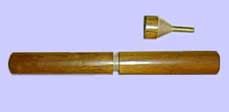 In 1819, the stethoscope was officially accepted as an instrument to be used to diagnose problems of the heart and chest.
The discovery of the stethoscope provided physicians and scientists a whole new world of sounds and means of diagnosis of many illnesses. The stethoscope of Laennec has undergone lot of changes, but his pioneering work is remembered even today, and the basic principle remains the same.
EXPLORE MORE...
Get Help or Give Help.
- Do you have a Science Question?
- Post it here and get the answer.
- Some questions posted by others are not yet answered.
- View those questions and answer them.
Dimdima is the Sanskrit word for ‘drumbeat’. In olden days, victory in battle was heralded by the beat of drums or any important news to be conveyed to the people used to be accompanied with drumbeats.
Bharatiya Vidya Bhavan
K. M Munshi Marg,
Chowpatty, Mumbai - 400 007
email : editor@dimdima.com
Bharatiya Vidya Bhavan
505, Sane Guruji Marg,
Tardeo, Mumbai - 400 034
email : promo@dimdima.com
Dimdima.com, the Children's Website of Bharatiya Vidya Bhavan launched in 2000 and came out with a Printed version of Dimdima Magazine in 2004. At present the Printed Version have more than 35,000 subscribers from India and Abroad.