Dimdima
Online Children's Magazine from India
Dimdima
Online Children's Magazine from India






The First American Spaceman
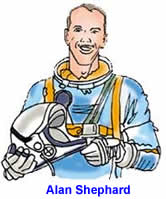
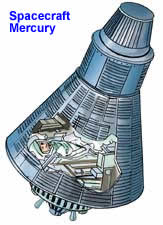
On 5 May 1961, two weeks after Yuri Gagarin had orbited Earth to become the world’s first spaceman, American astronaut, Alan B. Shephard was shot into space atop a Redstone rocket. His Mercury spacecraft, which he named ‘Friendship 7’, did not orbit Earth. It was a sub-orbital flight. Launched from Cape Canaveral, the spacecraft reached a maximum altitude of 187 kilometres and then dropped back to Earth to splash down in the Atlantic, 490 kilometres away.
 The whole flight took just over 15 minutes, but it lifted America into space and Shephard became a hero.
Elated by the success of the mission, the country’s new president, John F. Kennedy set a new goal of “landing a man on the moon and returning him safely to Earth” before the decade was out.
Mercury was a single-seat spacecraft like Gagarin’s Vostok, but unlike the spherical Vostok, Mercury was conical in shape, and smaller and lighter, weighing only 1.3 tonnes to Vostok’s 2.4 tonnes.
The craft re-entered Earth’s atmosphere bottom end down. The shield on the bottom protected the rest of the spacecraft and the astronaut from the heat that was generated as the spacecraft plunged to Earth.
On 21 July, the Americans sent another astronaut, Virgil Grissom into space. Grissom’s flight too was sub-orbital. His craft, ‘Liberty Bell 7’ shot out into space, went a little higher than Shephard’s, and then fell back to Earth. The hatch of the spacecraft accidentally blew off after splashdown, and the Liberty Bell sank, but Grissom was rescued by helicopter.
EXPLORE MORE...
Get Help or Give Help.
- Do you have a Science Question?
- Post it here and get the answer.
- Some questions posted by others are not yet answered.
- View those questions and answer them.
Dimdima is the Sanskrit word for ‘drumbeat’. In olden days, victory in battle was heralded by the beat of drums or any important news to be conveyed to the people used to be accompanied with drumbeats.
Bharatiya Vidya Bhavan
K. M Munshi Marg,
Chowpatty, Mumbai - 400 007
email : editor@dimdima.com
Bharatiya Vidya Bhavan
505, Sane Guruji Marg,
Tardeo, Mumbai - 400 034
email : promo@dimdima.com
Dimdima.com, the Children's Website of Bharatiya Vidya Bhavan launched in 2000 and came out with a Printed version of Dimdima Magazine in 2004. At present the Printed Version have more than 35,000 subscribers from India and Abroad.