Dimdima
Online Children's Magazine from India
Dimdima
Online Children's Magazine from India








The Hoshangabad district lies in the central Narmada Valley and on the northern fringe of the Satpura Plateau. It takes its name from its headquarters Hoshangabad, which was founded by Sultan Hoshang Shah Gori, the second king of Mandu (Malwa), in the early 15th century. Hoshangabad is a dusty little town with broken roads and small roadside shops. The better part of the town is where the Collectorate and other district offices are housed, and the Kothi Bazaar, which is not a market as its name suggests, but a quiet residential area.
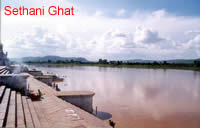
The Narmada Jayanti is celebrated at the Sethani Ghat here every January. Amarkantak is the only other known place in the Narmada valley where the river’s birthday is celebrated. The festival begins at the crack of dawn, with pilgrims chanting Narmadey Har (Praise be to the Narmada) 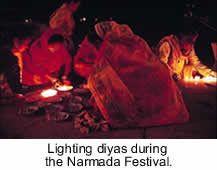 loudly as they take a dip in the river. Musicians announce the commencement of the Narmada abhishek by playing loudly on their dholak and shehnai. Before daybreak, the streets are lined with gaudily canopied stalls selling items of puja and eatables. Barbers shave off the heads of devotees who have pledged their hair to the river goddess. At around six in the evening the statue of Goddess Narmada, dressed in full splendour, is carried in a procession through the crowded streets, to the ghat. Priests offer panchamrut : milk, ghee, curd, honey and fruit, and at each oblation, the crowd shout out in unison : Narmadey Har . The festival’s most spectacular moment is at night, when devotees set afloat hundreds of lighted wax-filled aluminium diyas on the river.
| The Narmada is the only known river where a parikrama or a sacred circumambulation is performed. It is believed that by going around the river from source to mouth and visiting each of the holy places along the banks on foot, brings about salvation. The approximately 2200km trek takes roughly three years to complete. A person going on a parikrama is not allowed to carry any food, but is required to subsist on whatever is offered to him by the villagers living on the banks of the river. He is also not allowed to cross the river except at the estuary. |
Last updated on :12/5/2005
Dimdima is the Sanskrit word for ‘drumbeat’. In olden days, victory in battle was heralded by the beat of drums or any important news to be conveyed to the people used to be accompanied with drumbeats.
Bharatiya Vidya Bhavan
K. M Munshi Marg,
Chowpatty, Mumbai - 400 007
email : editor@dimdima.com
Bharatiya Vidya Bhavan
505, Sane Guruji Marg,
Tardeo, Mumbai - 400 034
email : promo@dimdima.com
Dimdima.com, the Children's Website of Bharatiya Vidya Bhavan launched in 2000 and came out with a Printed version of Dimdima Magazine in 2004. At present the Printed Version have more than 35,000 subscribers from India and Abroad.